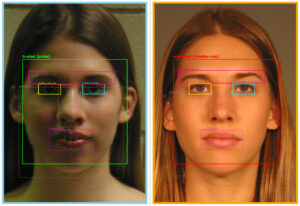
Kenan Gürbüz successfully defended his Master’s thesis on the topic „Analysis Framework for Super-Detector Gaze Behavior in Differential Classification Experiments“.
Abstract:
The human factor remains the most critical yet vulnerable link in security-critical identity verification. As digital face manipulation techniques, such as face morphing, become increasingly sophisticated, they pose a significant threat to border control systems by potentially allowing unauthorized individuals to bypass biometric checkpoints. While automated systems have improved, they are not infallible, placing the burden of detection on human operators whose performance is often limited and resistant to standard professional training. This thesis addresses the „lab-to-world“ disconnect in expertise research by shifting the focus from memory-based „Super-Recognizers“ to a task- and role-based definition of „Super-Detectors“ — individuals characterized by superior perceptual sensitivity in facial comparison tasks.
The primary objective of this work is the development of a computational eye-tracking analysis framework designed to quantify the gaze strategies of these elite performers. The methodology utilizes a multi-stage eye-tracking pipeline including a data-driven refinement protocol, that distilled an initial set of 39 variables into 11 core metrics across spatial, comparative, and temporal dimensions. This framework was validated across heterogeneous laboratory and virtual reality datasets to ensure the generalizability of the findings.
The results indicate that while Super-Detectors demonstrate a robust and significant sensitivity advantage over Typical Detectors, they do not employ a qualitatively distinct, universal „expert“ oculomotor signature. Instead, fundamental scanning behaviors, such as spatial concentration, fixation rates, and transition dynamics, are highly standardized across cohorts. These findings suggest that the performance gap is likely rooted in the cognitive efficiency of information processing within individual fixations rather than the physical distribution of gaze. While Super-Detectors exhibit context-dependent adaptive flexibility, such as a significant shift toward eye-centric prioritization in specific tasks, their expertise remains highly task-specific and lacks stability across different procedures. Ultimately, this work underscores the necessity of implementing task-analytic selection measures for security-critical roles, as superior detection performance is driven by flexible cognitive sampling rather than a singular, stable visual routine.