On July 14th, 2026, Lili Peter successfully defended her Bachelor’s thesis titled „Evaluation of Vision Language Models on Identity Verification and Manipulation Detection in Face Images“.
Abstract:
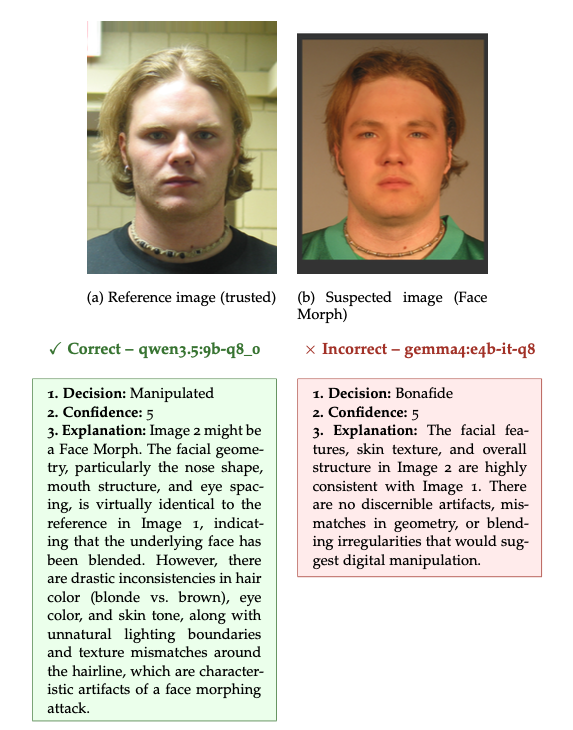
The increasing accessibility of face image manipulation software has made it significantly easier for malicious actors to generate highly realistic manipulated face images. Techniques such as face morphing and face swapping pose a serious threat to biometric security systems since they can be deceived at border controls and passport issuing processes. Vision Language Models (VLMs) are able to analyse and reason about images in natural language, making them a candidate for face manipulation detection, since, in addition to classifying images, they can provide explanations for their decisions. This work evaluates four off-the-shelf VLMs in the 4–9 billion parameter range, used with no task-specific fine-tuning: gemma4:e4b-it-q8, minicpm-v:8b-2.6-q8_0, qwen3.5:9b-q8_0, and qwen3-vl:8b-instruct-q8_0 on a dataset consisting of 54 face image pairs. Experiment 1 examines in how far a model can detect if two face images show the same identity, while experiment 2 evaluates whether a model can detect and classify face image manipulations given a two-shot prompt. The results show that the evaluated models are not yet capable of reliably detecting and explaining manipulations in face images: In Experiment 2, high accuracy is accompanied by high false-positive rates in many models, while high accuracy rates in Experiment 1 came with zero to very few correctly identified different identities. The findings suggest that VLMs in the given size range and without any fine-tuning and specific configurations are not yet capable of fully replacing existing detectors but may show potential as explainable support tools in combination with dedicated detection systems.