Burak Palaz successfully defended his Master’s thesis on „Identity-Preserving Facial Attribute Editing Using Multimodal Generative AI: Design and Evaluation of a Prototype for Forensic Investigation“.
Abstract:
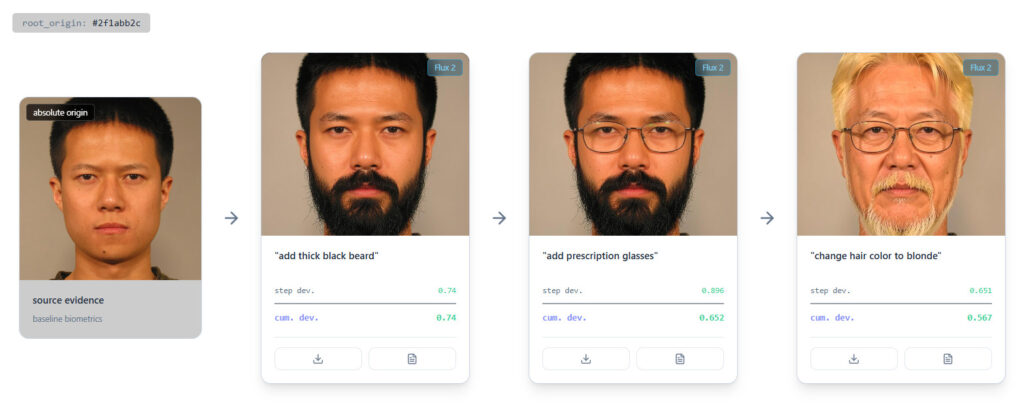
The deployment of multimodal generative artificial intelligence, in particular latent diffusion models, has shown substantial potential for forensic facial attribute editing, with specific applicability to age progression in missing person investigations. However, a fundamental tension persists between performing extensive semantic transformations and strictly preserving an individual’s underlying biometric identity. Following a comprehensive pre-evaluation phase to determine the most suitable generative architecture, this thesis introduces a dedicated forensic web application designed to systematically analyse this trade-off. The system incorporates a hybrid demographic extraction module to objectively verify demographic integrity, thereby driving an autonomous “Thinking and Reflection Loop” that employs dynamic target-age backoff to constrain the behaviour of a zero-shot FLUX model.
The performance of the proposed system was assessed against an inversion-based baseline (FADING) using a stringent, multi-stage “Forensic Survival Funnel,” which evaluated chronological convergence, demographic consistency, and biometric preservation (via AdaFace). Quantitative findings indicate that the autonomous reflection loop is effective in regulating the generative process. By leveraging demographically anchored declarative prompts, the system reduced hallucinatory age error by an average of up to 23.43 years and attenuated the “Percentage Fallacy,” thereby increasing demographic retention to 87.3%. Nevertheless, the final biometric analysis reveals a critical structural limitation of text-conditioned generative architectures. For extreme 30-year age-progression targets, the repeated pixel-level manipulations required to enforce chronological convergence systematically disrupted the subjects’ spatial facial morphology, leading to a pronounced decline in the biometric survival rate of FLUX to 2.0%. In contrast, the FADING baseline exhibited strong inherent preservation of biometric identity (96.0% survival), but faced difficulties in achieving precise chronological accuracy.
The thesis concludes that standalone zero-shot text-to-image models are structurally unsuitable for deep, identity-critical forensic age progressions. The proposed hybrid sequential architecture is envisaged as a blueprint for future operational deployments, whereby FADING is employed for morphology-preserving age transformations and FLUX is reserved exclusively for high-fidelity, additive facial modifications.